Split level timber frame house overcomes steep site

Cork city split level timber frame house with passive solar design, rainwater harvesting, renewables & green material

Welcome to the archive of Construct Ireland, the award-winning Irish green building magazine which spawned Passive House Plus.
The feature articles in these archives span from 2003 to 2011, including case studies on hundreds of Irish sustainable buildings and dozens of investigative pieces on everything from green design and building methods, to the economic arguments for low energy construction.
While these articles appeared in an Irish publication, the vast majority of the content is relevant to our new audience in the UK and further afield. That said, readers from some regions should take care when reading some of the design advice - lots of south facing glazing in New Zealand may not be the wisest choice, for instance.
Dip in, and enjoy!
Cork city split level timber frame house with passive solar design, rainwater harvesting, renewables & green material


The world has learned the hard way that our political leaders lacked the judgement and resolve to identify and address the problems which led to the recession. Richard Douthwaite argues that a similarly flawed judgement is evident in the assumption that the economy will recover, and advises on how to prepare for a future of global economic contraction.

Richard Douthwaite reveals that oil and gas peak are barely mentioned in the Government's recent energy Green Paper.
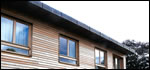
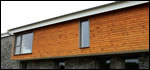
An experienced timber framer with an eye for detail, Tim O'Donovan set about building a low energy stick-built home in the Cork countryside and achieved a staggering level of airtightness.
Words: Lenny Antonelli
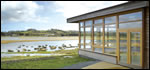
Designing a low-energy public building with passive ventilation and lighting in mind is one thing – making it fit seamlessly into a rural wetland environment is quite another. Lenny Antonelli visited the award-winning Ballybay Wetlands Centre in County Monaghan - a closed-panel timber frame structure designed to sit softly on the surrounding landscape.

Conventional wisdom dictates that higher construction costs — for instance to reduce energy consumption and carbon emissions — would either squeeze developers’ profit margins or increase house prices. Tom Dunne, Head of DIT’s School of Real Estate and Construction Economics, reveals how misguided this view could be...
As fossil fuel prices rise, the need for energy efficiency in achieving both is increasingly leading Irish people to an approach which combines both ventilation and heating,