

- Insight
- Posted
Life cycle assessment in construction and retrofit
Life cycle assessments are crucial for sustainable building design, but understanding their inherent limitations is key to making better decisions with imperfect data, writes Dr Lois Hurst.
I recently wrote about the predominance of life cycle carbon compared with life cycle energy. Now that you are all convinced about the importance of considering both metrics together, I want to press home some of the reasons why you need to be at least a bit sceptical about both measures. From what I can see, life cycle, also known as whole-life, is commonly presented as a sort of gospel truth. The numbers are reported with conviction and authority. It’s true that life cycle studies are the best tool we have, so we really should continue to utilise them. But we should also be taking the reported figures with a pinch of salt – and at least acknowledge their limitations.
Firstly, when considering how a life cycle study is delivered, we need to understand a few basics. Suppose you commission a life cycle study for a construction project — probably a new or retrofit house/houses, or maybe a commercial or municipal building. To do this, you, or your analyst gathers together the life cycle inventory for the building project. This inventory is the list of materials/products, and quantities you’re going to use. Then, usually using some software, you draw on data sources – perhaps environmental product declarations (EPDs), or a database like the ICE database – and populate the inventory with impact data. From this, life cycle impacts for that project can be summed together, to produce an impact analysis.
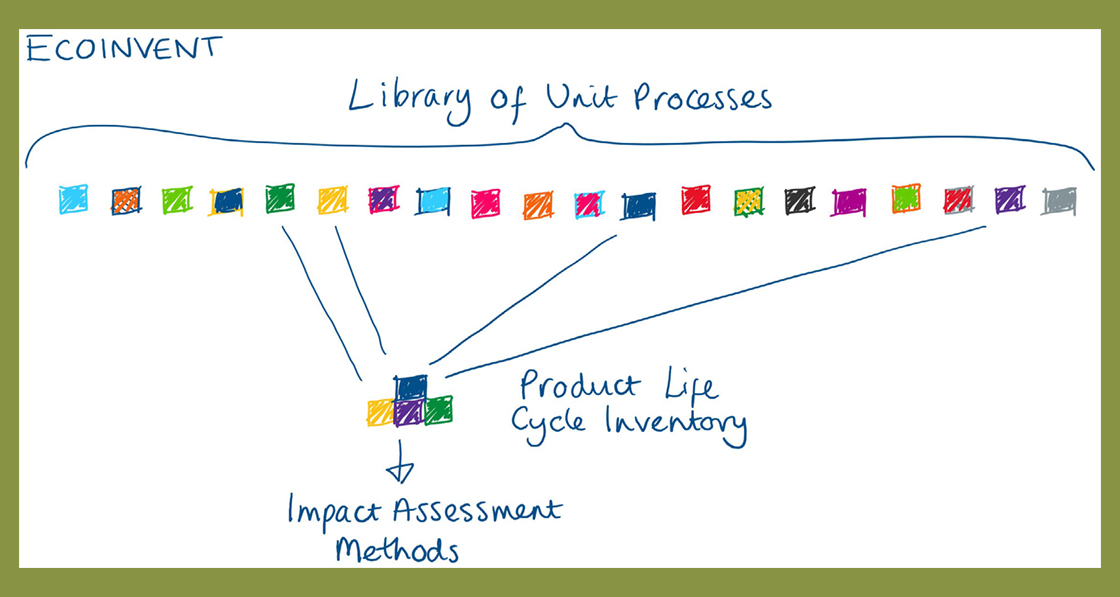
Figure 2: A visual representation of how Ecoinvent develops its embodied impacts, via the development of an Inventory, built up from a library of unit processes.
But how do you know whether the data you are using in the analysis is giving certainty in the results? The data you collect to populate your inventory — whether it’s for insulating wall board, aluminium profiles, or bricks — is developed in the same way; identifying the ingredients/components/materials which go into that product, developing an inventory, and attributing impact data. And so it goes, down to each input at each layer of the system. The Ecoinvent database describes assembling a “library of unit processes”, such as “electricity production”, “transport”, or “production of insulation”, illustrated in Figure 2. A software product like SimaPro then uses these to develop embodied impacts for a material, component, or even a building.
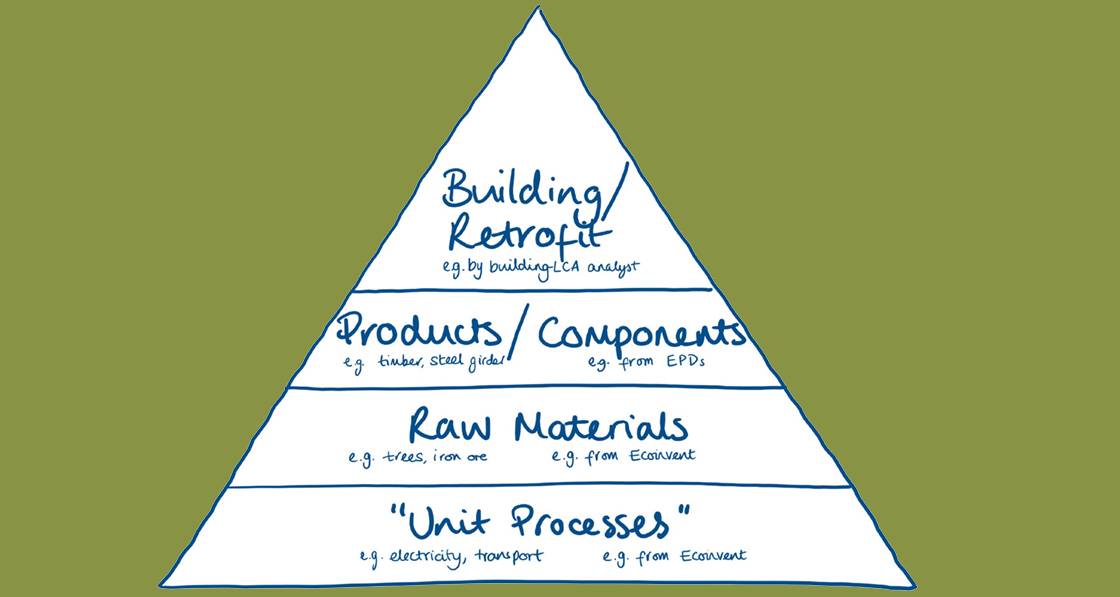
So in fact, the life cycle assessment (LCA) undertaken for a building or retrofit, is a bit like a pyramid, comprised of layers and layers, probably amounting to hundreds of LCAs for individual inputs, as illustrated in figure 1 (the image on the title of this article).
But do we have certainty in our data in each of these layers? Really, we have two aspects to consider; the building analysis — the top tier of the pyramid — is the bit we building practitioners tend to be involved with; then the lower tiers are usually addressed by the people supplying the data — the consultants hired to evaluate a manufacturing process, or an analyst developing LCA databases and tools.
This article was originally published in issue 51 of Passive House Plus magazine. Want immediate access to all back issues and exclusive extra content? Click here to subscribe for as little as €20, or click here to receive the next issue free of charge
Let’s start with the more familiar territory in the top tier; once we bring the potential impacts of all these material additions together, we are able to evaluate the life cycle energy or carbon. For a new building, we arrive at a figure combining embodied and operational impacts over the reference service life, and may benchmark that against guidelines, or even mandated values, and redesign if need-be. With a retrofit, there is a more subtle evaluation which considers the balance between the retrofitted operational savings and the embodied costs, which might inform whether we proceed with the retrofit or not.
In relation to this top tier of the pyramid, there are many opportunities for variation and uncertainty. The nuance becomes important here. Where have we drawn the boundaries for the study? In a retrofit, is it the physical limits of the retrofit itself? If so, I assume we are counting the house’s operating energy, and embodied impacts of the insulation, but what about the replaced kitchen tiles (which were looking a bit tired), the re-paved driveway, or the new solar panels? And should we offset the renewable energy from the solar panels when we calculate the operating energy, even though we didn’t do that before because we bought our renewable energy from a mains provider?
Then there are the lifecycle phases (also referred to as system boundaries – the cradle-factory gate-grave stuff), and — hang on — what about including the existing structure? And was there a truncation error? Did we account for all the components, or did we deem some to be so insignificant as to be not worth including?
There is a lot here to unpick. When it comes to LCAs for finished buildings or retrofits, we need to know that each of those analyses was delivered in the same way, with comparable methods. This is where guidance like the Royal Institution of Chartered Surveyors (RICS) “Whole life carbon assessment for the built environment” 2nd Ed. come into play.
This goes a long way to ensuring continuity of the approach used between one project or another but having reviewed the RICS guidance in detail and used it as the basis for some quantitative analysis, there is still a lot of room remaining for interpretation. This is inevitable, because each analysis will be undertaken for a specific reason, and controlling the variables to the nth degree could lead to the analysis being useless for the purpose it was intended.
Nevertheless, if there is a desire or need to compare results, benchmark etc, it is necessary to absolutely define specific details, even to the point where it might be advantageous to produce a second, parallel analysis to ensure a fully standardised result. But beyond this, RICS also has room for a lot of subjectivity, especially when using the “Scenarios”.
The RICS scenarios are intended to simplify some of the many assumptions which must be made in an analysis, but often, I found it was oversimplified. For example, RICS offers a table of “waste rates” to enable an estimate of the amount of a material which when brought to site, is wasted as offcuts, packaging or surplus.
They offer five types of concrete, three of timber, but insulation is represented as just one entity; there is no way to differentiate sheet or rigid materials like foil-faced PIR or wood fibre boards from formable products like batts, spray-on products like PU foam or Diathonite, or loose-fill materials like cavity wall beads and cellulose fibre. There is no category for materials like fixings, sealants, membranes and tapes. While in a huge construction project these might be omitted as insignificant, the same shouldn’t be assumed for a small-scale domestic retrofit. These layers of assumptions, simplifications, and subjective interpretations of study boundaries, including physical as well as system boundaries, can lead to ambiguities in the results—especially when there is an intention to compare that result with other projects.
Now considering the data at the product-tier of the pyramid or below, what assumptions were made for that data collection? Was precisely the correct material or product data available? Was that product data geographically or temporally representative of the system being developed? Was the method used for this material or input consistent with, and therefore comparable with another material or input? And at the very basic level of semantics, was the material specified given the same name in the impact datasets?
I found product and material names alone generated a huge amount of ambiguity. While EPDs do include a detailed description of the material in question, between Ecoinvent and the ICE database I was unable to align numerous materials because their names were different and neither gave a description.
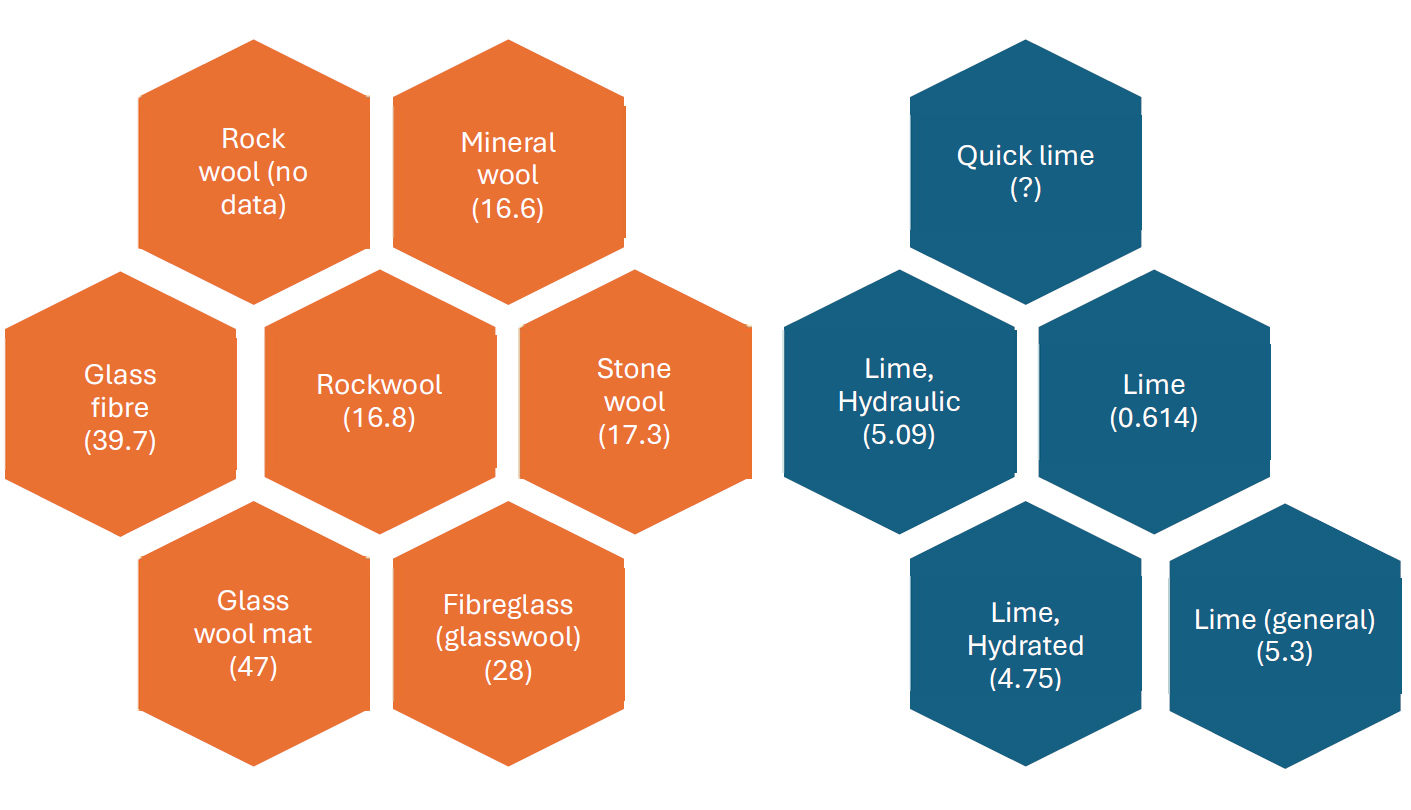
Figure 3: Examples of naming ambiguities in LCA datasets; Similar sounding products with in some cases widely different values for embodied energies (given in MJ/kg), or in some cases, e.g. quicklime, with no data found.
Figure 3
As illustrated in Figure 3, examples include
- mineral wool, Rockwool, rock wool and stone wool, which while similar in application and appearance, are quite different in their embodied energy and carbon values to fibreglass (glasswool) and glass wool mat
- base plaster, stucco, cover plaster, mineral, plasterboard and gypsum plasterboard, with stucco proving to be the most suitable to describe general gypsum plaster
- lime (general) versus hydrated or hydraulic lime or a record was found for simply lime (which transpired to be agricultural lime—usually crushed limestone—so quite unsuitable as a binder in mortar).
It sounds trivial on the face of it, but if a material can’t be identified for what it is, by the name it is known by, representative values for its embodied impacts cannot be used in the analysis. Consider an analyst developing an EPD for your product and having to identify the most representative data point: Either an unsuitable data point is used, or a suitable or unsuitable surrogate or alternative data point is used, thus introducing a new layer of uncertainty. A similar problem lies with data for materials being unavailable, where the brand or product type does not have embodied impact data attributed, or data cannot be found. In these cases, it is necessary to substitute with a proxy material, often with unsuitable technical, or geographical relevance.
For example, in an analysis I undertook in 2023/24, I was unable to find an EPD for quicklime for a UK project. I had to substitute with “lime, hydrated products”, from Australia — a chemically different material, from the wrong side of our planet. Similarly, for a domestic MVHR unit, I resorted to using a similarly-sized product from a Finnish company, rather than the unit specified, because I thought there was no EPD available, instead choosing one that was both technically and geographically less relevant.
As it happens, an EPD by Zehnder was published at around the time I was undertaking that analysis, but I didn’t find the EPD — which perhaps highlights another challenge — sourcing this data is time consuming and oftentimes from widely disparate places, adding to the complexity of the LCA — and potential for user error or oversight.
And then there’s the can of worms of the methodological challenges associated with generating a lifecycle inventory for the materials and products — more uncertainty. Does your data source or EPD explain how complete the estimate is? Was there truncation error at that level, and possibly substantial underestimation of the embodied impacts? Or perhaps inputoutput analysis was used, which assumes – perhaps fairly – a linear relationship between product price and embodied impact.
Waste materials and coproducts are especially relevant when considering end-of-life impacts, but how were they allocated? Were they attributed to this life-cycle, or the next? And of course there’s the biogenic fraction discussion. There’s the inclusion of the energy content of the material itself. There’s bio-derived heat or power for material processing (e.g. using timber offcuts). And there’s the carbon storage possibilities with biogenic materials.
Are these things handled comparably across all materials in your inventory? These complexities refer to the methodology behind the data collection. Much of this (for EPDs at least) is prescribed to some degree by product category rules (PCRs), based on ISO 14025 and ISO 14040/44, which do include a “data quality” evaluation. But there is no quantitative determination of data certainty, and not all EPDs report that data quality — so the user has no way of evaluating this, and nor is it brought through to the analysis of your building project.
In some cases, the biggest variation in embodied impact studies arises from study design and methodological choices, rather than inherent variations in the design of the building.
Moreover, if material embodied impacts are derived under different product category rules, then the results are – strictly speaking – not comparable anyway, which means that technically, the impacts shouldn’t be added together when analysing a complete building.
So, if we come back to why we might want to undertake a life cycle study in the first place, surely it should be so that we can improve the building’s design in such a way that the life cycle carbon and energy can be minimised? Unless we’re simply box ticking, we want and need to have confidence in the data that we’re using to develop our building life cycle values.
But what is the effect of this complexity? The upshot is that through this whole process, incremental layers of ambiguity and uncertainty are aggregating, compounding and accumulating, to the extent that I sometimes question how much confidence we can really have in the end result. While the contribution to the uncertainty will be small – or perhaps tiny – on the lower tiers of the pyramid, there are many, many contributors, so perhaps it shouldn’t be dismissed too readily. Scientific research has shown that in some cases, the biggest source of variation in embodied impact studies actually arises from study design and methodological choices, rather than inherent variations in the design of the building, and thus emphasises the need for consistency and solid guidance. EPDs and product category rules have done a lot of good in standardising the approach to LCA, and guidance for the building level, such as RICS, is very much needed. However, scope for uncertainty remains in many of the factors I have described. When decisions about building specifications and materials are being made based on the results of LCA – decisions which have upfront and long-lasting carbon emissions associated with them - it is of utmost importance that we can place confidence in the data being used and in the results obtained.